• BIO
  • VIDEOS
  • FOTOS
  • ENLACES
  • AGENDA
  • PRENSA
  • CONTACTO
  • Español
    • Español
    • English

Crítica

Powerhouse performances by baritone Andrei Kymach and bass-baritone Yuri Kissin deliver a solid start to Opera Australia’s 2023 season.

LIMELIGHT

January 6th, 2023. Jansson J. Antmann

If you needed just one reason to attend this revival of David McVicar’s 2014 production of Don Giovanni, it would be the opportunity to witness the Australian debuts of Ukrainian baritone Andrei Kymach and French-Israeli bass-baritone Yuri Kissin.

In the title role, Kymach commands the stage and his presence is felt before he has even sung a note. The winner of the 2019 BBC Cardiff Singer of the World, Kymach delivers a vocal masterclass, and his dexterity enables him to make child’s play of his so-called ‘Champagne aria’. It is, however, his serenade “Deh! vieni alla finestra” that truly shows off his seductively dark and velvety voice. Like the countless victims of Don Giovanni’s feigned affections, it is hard not to swoon.

Seguir leyendo en Limelight

Dark, unflinching production unmasks serial rapist Don Giovanni

THE SYDNEY MORNING HERALD

January 6th, 2023. Peter McCallum

When Opera Australia flashed trigger warnings of impending violence against women in its recent production of Carmen on Cockatoo Island it was unclear whether the motivation was concern or dramatic irony. The absence of such warnings in David McVicar’s production of Don Giovanni suggests it must have been the latter.

Though Mozart’s work uses the formal framework of Italian comic opera, McVicar’s conception finds nothing of charm or comedy in the behaviour of its eponymous serial rapist, while masked fornicators thrust away in Robert Jones’ sets of crumbling stone and David Finn’s sepulchral lighting.

As Don Ottavio, betrothed of Donna Anna, earnestly pursues evidence, the empowering moment comes right at the close when it is the women Don Giovanni has previously wronged – the ghosts of all those in Leporello’s famous “catalogue” aria – who rise up behind the Commendatore, stone statue of paternalism, and drag him down to hell.

Seguir leyendo en THE SYDNEY MORNING HERALD

LA ITALIANA EN ARGEL TRIUNFA EN EL MUNICIPAL

VISIONES CRÍTICAS

14 de Octubre, 2019. Gilberto Ponce.

Cuando frente a una obra de arte decimos que estamos experimentando un goce, hablamos de la sensación de placer que nos provoca su observación, siendo al mismo tiempo, la concreción objetiva de lo que se propuso su creador, podemos decir entonces que se produjo el cierre del “círculo mimético”, como dicen algunos, esto es, el propósito del artista se encontró con el que contempla.

Ahora, lo anterior se aviene perfectamente con lo ocurrido en los estrenos de los dos elencos, de la ópera bufa de Gioacchino Rossini, “La Italiana en Argel”, ya que fue posible observar ese goce en el público, haciéndonos pensar en el goce que el compositor tuvo al escribirla, algo que sabemos, ocurrió en un espacio de tiempo muy breve.

Pero no es suficiente que la obra sea una de las tantas obras maestras de Rossini, pues para lograr ese resultado, es preciso contar con un equipo tan sólido en propósitos, como el que se tuvo en esta oportunidad, tanto en lo musical como en régie, escenografía, vestuario e iluminación, que conjugaron tal unidad de propósitos, que consiguieron un rotundo éxito, ello explica las entusiastas ovaciones del final, así como las carcajadas durante la función.

Seguir leyendo en Visiones Críticas

Segundo reparto de «Il viaggio a Reims» en el Liceu

PLATEAMAGAZINE

23 de Setiembre, 2017. Jordi Maddaleno

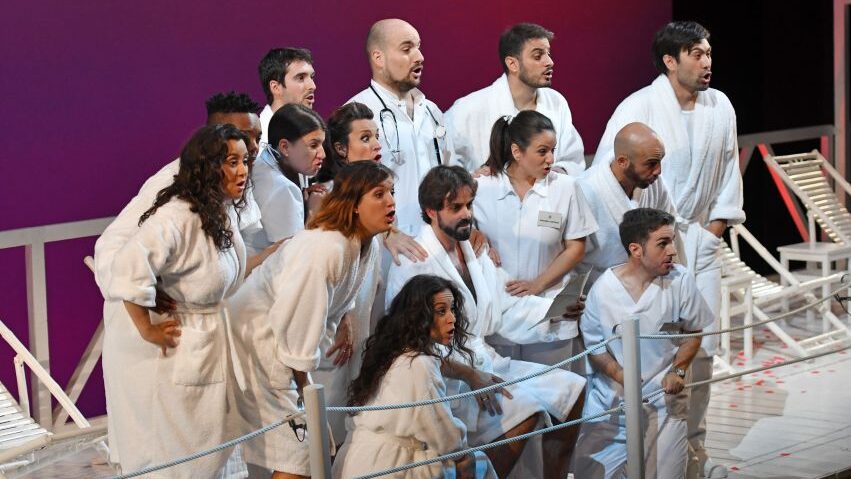
Puede sonar extraño que el Gran Teatre del Liceu haya escogido Il viaggio a Reims de Rossini para empezar su nueva temporada de ópera, aunque este título no se considere su inauguración oficial, cosa prevista con el estreno de Un ballo in maschera de Verdi el próximo sábado 7 de octubre. Ofrecida así pues como un entremés a la espera del título escogido como oficial, artimaña de marketing que también hacen otros teatros como el Palau de Les Arts de Valencia, hay que destacar el éxito de una propuesta en cierto modo arriesgada pero también de resultado artístico más que satisfactorio.

Ópera coral por el gran número de roles a los que se han de enfrentar casi una veintena de solistas, la apuesta de mezclar voces jóvenes, debuts, rol-debuts y que catorce de los veintisiete cantantes que se han alternado las siete funciones en varios repartos sean españoles, hacen que se pueda hablar de esta propuesta como un relativo éxito. Al menos en este título no se le podrá criticar al Liceu y a su directora artística Christina Scheppelmann que no hayan apostado por las voces españolas, ya consagradas o jóvenes debutantes, que han ayudado con su profesionalidad y brillantez vocal a dar en la diana con una ópera nada fácil, pero llena del mejor belcanto de la escuela rossiniana.

Seguir leyendo en Pateamagazine

KIRCHSTETTEN/ Schloss/NÖ: IL BARBIERE DI SIVIGLIA

ONLINEMERKER

5 August, 2017. Elena Habermann

Warum man die Idee von Beaumarchais unbedingt bearbeitet muss und die Handlung holprig ins Heute überträgt, fragt man sich. Das Stück, der erste Teil der „Figaro Geschichte“, ist an sich schon zeitkritisch. Eine absolute Anklage an die Aristokratie. Regietheater um jeden Preis sollte nicht im „Sommertheater“ stattfinden.

Abgesehen von Regieungereimtheiten und nicht ganz passenden Kostümen kann man aber sagen, diese Produktion ist sicher besser als so manches derzeit an der Wiener Kammeroper, jedenfalls musikalisch.

Sängerisch gab es auch wirklich sehr gute Leistungen. Der junge spanische Tenore di grazia Juan de Dios Mateos als Conte Almaviva singt die schwierigen Kadenzen wirklich hervorragend. Eine schöne, gut geführte Stimme, die sicher auch in einem größeren Haus sehr gut über die Rampe kommt. Der gut aussehende junge Sänger spielt auch lustig und animiert. Demnächst kann man ihn als Narciso in Oviedo alternierend mit David Alegret erleben.

Seguir leyendo en Onlinemerker

A for effort, but mixed achievement for an ambitious Les fêtes d’Hébé

BACHTRACK


April 6th, 2017. David Karlin

Hebe, goddess of youth and cupbearer of the gods, has got fed up with Mount Olympus, not least with the unwanted attentions of Momus, god of satire and mockery. She wings it down to earth, where she alights (where else) on the banks of the Seine, to discover a raft of festivities awaiting her, each representing the lyric talents of poetry, music and dance – from the pen of none other than the court composer par excellence, Jean-Philippe Rameau. Back in 1739, the glorification of Paris as the centre of the artistic world can’t have been missed by a single audience member.

It takes a brave company to turn Les fêtes d’Hébé, ou Les talens lyriques into something suitable for a London audience: the opéra-ballet form is so far from our current concept of opera and we lack so much of the cultural context that would have been so familiar to the denizens of Paris in 1739 – even in South Kensington, with a substantial body of French people in the audience.

Seguir leyendo en Batchtrack
« Recent News
Copyright © 2023 Juan de Dios Mateos. All rights reserved.
Website crafted by ElAmmaDeLlaves